
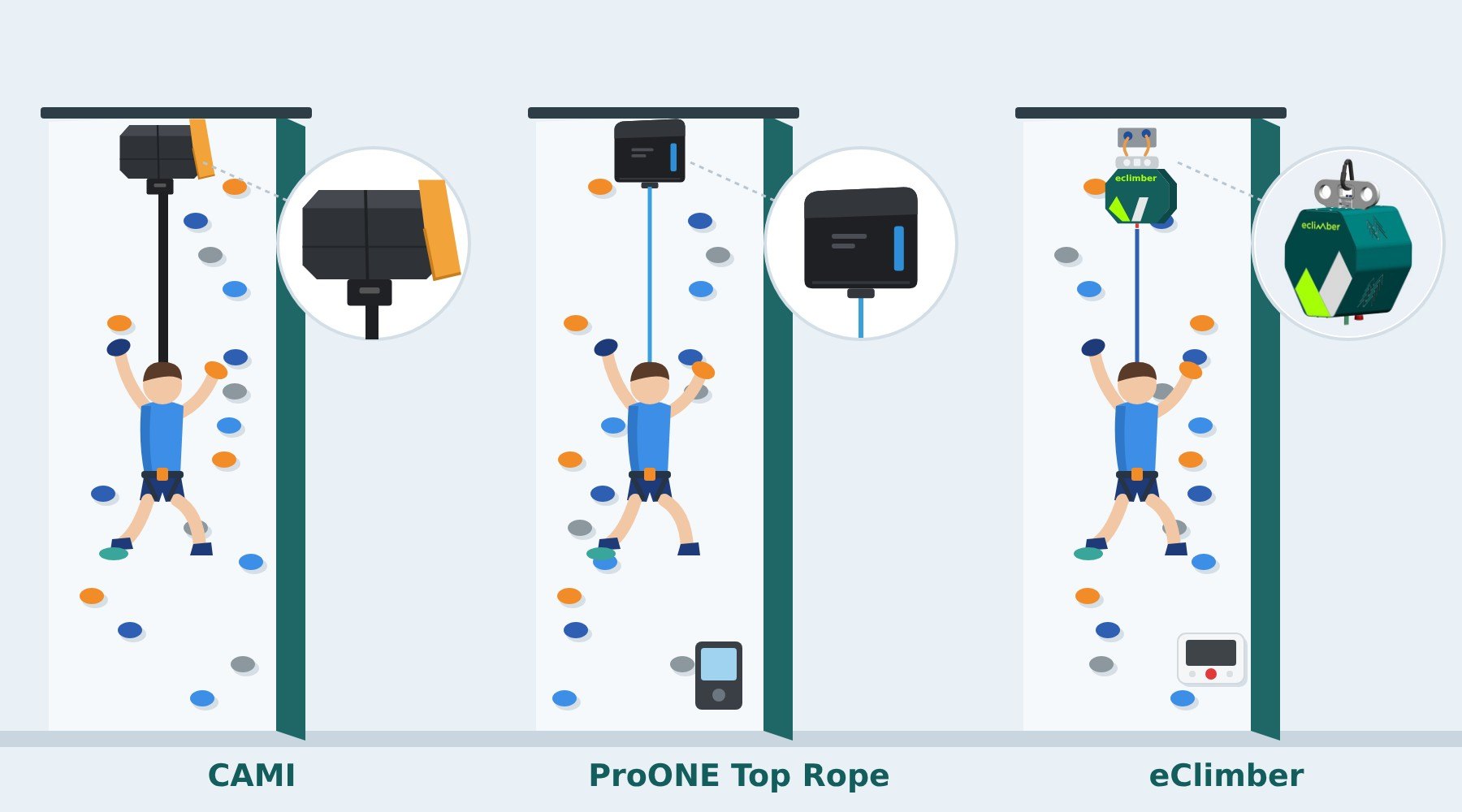
A classic auto belay, such as TRUBLUE by Head Rush or the devices by Perfect Descent, takes in the rope while you climb and then lowers you slowly. But you still have to climb on your own, with your full body weight.
Today there are devices that do more: while you climb, they take off an adjustable part of your body weight, much like an e-bike. This makes climbing inclusive: the wall opens up to many people for whom it was unimaginable before, whether in therapy, with a disability, in later life or just starting out.
We are convinced: assisted climbing is the future. We already know of three providers, and the topic is here to stay. With this article we simply want to show what already exists. With the eClimber we are developing one of these devices ourselves and hope to stay in the game. Either way, someone will make it, and everyone who could not climb until now will benefit. All data comes from the manufacturers’ websites and documents (as of 4 November 2026).
What is an assisted auto belay?
An assisted auto belay is a self-belay device for top-rope climbing with a motor. The motor pulls on the rope and so relieves the climber of a chosen share of their weight. Like a normal auto belay, the device also belays the climber and lowers them at the top.
CAMI by MBS Industry (Colmar, France)
MBS Industry from France makes the motorised auto belay CAMI, part of the “Footing Vertical” programme. According to the manufacturer, it takes off up to 95% of body weight and can also be used as a normal auto belay without assistance. Even then, however, it needs power. It is designed for people with a body weight of 20 to 160 kg and can be installed up to 25 m high. As with many classic auto belays, a webbing strap is used instead of a rope. It is operated with a remote control on the strap or a web app.
The CAMI has two brakes that also work without power: a centrifugal brake and a magnetically preloaded brake that engages if the lowering speed is too high or the power supply fails. An additional battery keeps the device running during a power cut, so the brake does not have to step in straight away for lack of power.
An emergency stop is also built in, but at the top of the device. So it is there; in an emergency you just have to reach it first. Whether that is the most practical place for it, everyone can judge for themselves.
On conformity, the manufacturer publishes a self-declaration as a class I medical device. The documents listed here do not show which independent safety tests have already been carried out. To our knowledge, certification with TÜV in Munich is currently under way. We very much welcome this. In our view it would be even better if the independent assessment were completed before the devices go into use. Until then, our anticipation of the certificate is in any case greater than our peace of mind.
We apply the same standard to ourselves: the type examination of the eClimber by Suva is still under way.
Manufacturer’s page: mbs-industry.com
ProONE Top Rope by ProGrade (Italy)
ProGrade is known for ProFIVE, an auto belay for lead climbing. With ProONE Top Rope, according to its website, ProGrade offers a top-rope auto belay with adjustable weight relief of up to 40 kg. Each climber selects their assistance on a display at the base of the wall. According to the manufacturer, the device suits walls up to 17 m. According to the manufacturer’s page, it is available from July 2026.
Manufacturer’s page: prograde.it
eClimber (Biel, Switzerland)
The eClimber was created at Bern University of Applied Sciences and is now developed and built in Switzerland as a spin-off. It hangs at the top of the wall like any auto belay and, in top-rope climbing, belays people up to 150 kg, up to 20 m climbing height. Before starting, you set how many kilos it should take off, continuously up to 100 kg.
The motor helps, the mechanics keep you safe: an integrated brake catches a fall purely mechanically. If the power fails, the brake holds and a spring keeps taking in the rope. The eClimber is designed to EN 18039:2026 for auto belays and EN 341:2011 class A. Type examination by Suva is still under way.
Installation needs no changes to the wall: the eClimber hangs from a single point on an existing auto belay mount and is easy to move to another route.
More on the product page.
The systems at a glance
| CAMI | ProONE Top Rope | eClimber | |
|---|---|---|---|
| Manufacturer | MBS Industry, France | ProGrade, Italy | eClimber, Switzerland |
| Assistance | up to 95% of body weight | up to 40 kg | up to 100 kg, continuous |
| Climber weight | 20 to 160 kg | – | up to 150 kg |
| Operation | remote control on the strap or web app | display at the base of the wall | control panel |
| Climbing height | installation up to 25 m | up to 17 m | up to 20 m |
| Installation | bolted to the top of the wall | bolted to the top of the wall | single point on an existing auto belay mount, no changes, can be moved to other routes, installation by us on request |
| Power | normal 230 V socket, with battery | – | normal 230 V socket |
| Certification | class I medical device (EU 2017/745), manufacturer’s declaration of conformity | – | designed to EN 18039:2026 and EN 341:2011 class A, type examination by Suva under way |
| Purchase | approx. €36,000 | – | CHF 14,870 excl. VAT |
| Rent | €599 per month excl. VAT, 36 months, France only, device exchange, support and software updates included | – | CHF 220 per month excl. VAT, 36 months, insurance and service included |
| Rent per year | €7,188 excl. VAT | – | CHF 2,640 excl. VAT |
“–” means we have not yet found public information on this. We will update the comparison as soon as more recent information is available.
What gyms can look at
- How much assistance is needed? The more kilos a device can take off, the more people can climb, even with severe limitations. Our rule of thumb from practice: ideally, a device can take off around 75% of body weight. The question is: how inclusive do we want to be, and how much inclusion can we afford?
- Target group: therapeutic climbing, people with disabilities, older people or beginners?
- Installation: how easy is the device to install? Does it need changes to the wall or trained staff? Can it be moved to another route?
- Service: what does it mean for operations? Who maintains the device, how often, and who changes the rope or strap? How much staff training does it take?
- Power and safety: what happens during a power failure? Which standards and tests does the device meet?
- Offer: buy, rent or test first?
The best way is to try the devices yourself. You can try the eClimber at locations in Europe or test it for two months in your gym: request a trial.
Note
This article was written by the eClimber team, so by one of the manufacturers named. The data on the other devices comes from their websites and may change. We keep this overview up to date. Have we missed something, do you know another device, or has something changed? We’d love to hear from you: info@eclimber.ch.